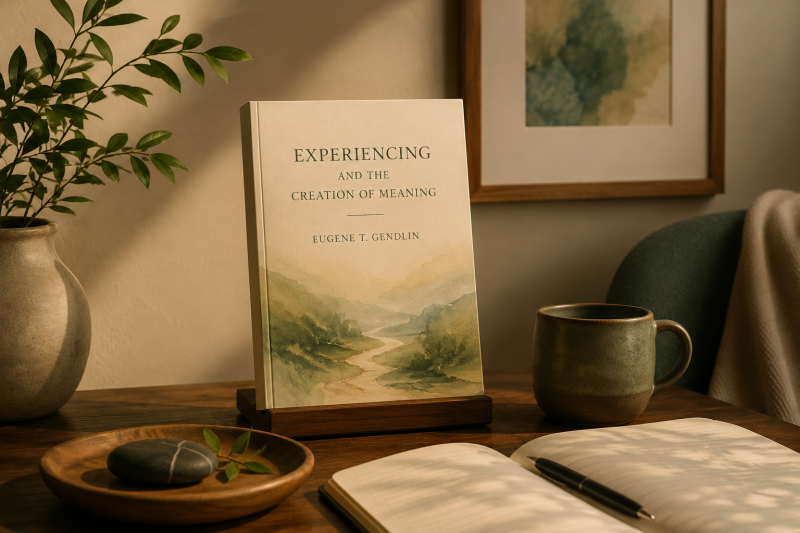
By Anna Moochoon, LCPC
Most of us have had moments when we knew something before we could explain it.
A relationship feels different before there has been a conversation.
A decision looks good on paper, yet something in you hesitates.
You walk into a room and sense tension before anyone says a word.
Or perhaps you have said:
"I know what I mean, but I can't find the words."
According to philosopher and psychotherapist Eugene Gendlin, these moments are not failures of thinking. They reveal something important about how human beings create meaning.
We often know more than we can say.
Gendlin called one form of this knowing the felt sense.
What Is a Felt Sense?
A felt sense is a bodily felt awareness of an entire situation.
It is not simply an emotion.
It is not merely a bodily sensation.
It is the body's sense of the whole thing.
Imagine someone asks, "How do you feel about your career?"
You may not immediately have an answer. Yet if you pause, you might notice something: a heaviness, a tightness, a sense of pressure, or a feeling that something is not quite right.
The feeling may be vague, but it is meaningful.
It may contain hopes, fears, values, disappointments, possibilities, and unanswered questions all at once.
That is close to what Gendlin meant by a felt sense.
The Relationship Example
Imagine someone who has been in a relationship for years.
Nothing dramatic has happened. There have been no major arguments. No obvious crisis.
Yet something feels different.
When asked about the relationship, they might say:
"I don't know. Something just feels off."
At first there are no explanations. Only a vague feeling.
A heaviness.
A distance.
A subtle ache.
Weeks later, after paying attention to that feeling, a realization emerges:
"I think I've been lonely for a long time."
The loneliness did not suddenly appear.
The words appeared.
The experience was there first.
More Than an Emotion
One of Gendlin's important observations was that a felt sense is not the same thing as an emotion.
An emotion is often recognizable.
You know you are angry.
You know you are afraid.
You know you are sad.
A felt sense is broader.
A person may know they are angry with a partner. Yet beneath the anger there may be a larger sense involving disappointment, longing, uncertainty, grief, hope, and unresolved questions.
The felt sense contains the complexity of the whole situation.
It is not one feeling.
It is many meanings held together before they have been sorted into categories.
Vague Does Not Mean Imprecise
The felt sense often begins as something vague.
People may say:
"I don't know."
"It's hard to explain."
"I can't quite find the words."
Yet Gendlin did not see this vagueness as meaningless confusion.
In fact, the felt sense can be more precise than our first explanations.
A person may begin by saying, "I'm angry."
But if they stay with the experience, they may notice that anger does not quite fit. The feeling may be closer to disappointment, loneliness, grief, or a sense of being unseen.
When the right words arrive, the body often responds.
There may be a softening.
A breath.
A sense of recognition:
"Yes. That's it."
The felt sense may begin vaguely, but it is not empty. It often contains distinctions that our usual concepts have not yet captured.
Why We Know More Than We Can Say
For Gendlin, human experience is richer than our concepts.
We are continuously interacting with the world. Our bodies respond to relationships, memories, goals, fears, hopes, and possibilities long before we consciously analyze them.
This is why we may sense that something is wrong before we can explain why.
The body is not separate from the mind, sending messages from somewhere else.
The body is already participating in the situation.
It is already living the relationship, the decision, the conflict, or the possibility.
The felt sense is one way this deeper knowing becomes available.
The Felt Shift
Something important can happen when people stay with a felt sense rather than rushing to explain it.
A word appears.
An image emerges.
A new understanding develops.
The body responds.
Breathing deepens.
Tension softens.
Something feels different.
Gendlin called this a felt shift.
The situation itself may not change immediately, but the person's relationship to it changes. Something that was unclear becomes clearer. Something that was stuck begins to move.
Many people experience this as relief.
Others experience it as clarity.
Some simply say:
"That's it."
The words fit.
The experience moves.
Carrying Forward
Gendlin believed that life is always moving toward its next step.
Every situation contains possibilities that have not yet become fully visible.
When a felt shift occurs, the process moves forward.
He called this carrying forward.
A person may not solve the whole problem at once. But something new becomes possible.
A new conversation.
A new decision.
A new perspective.
A new understanding.
Growth, in this view, is not simply discovering answers. It is allowing life to continue unfolding.
Creativity, Insight, and New Ideas
Gendlin later connected the felt sense to creativity and discovery.
Scientists, writers, artists, and researchers often describe a knowing that comes before explanation.
A scientist may sense that a theory is promising before being able to prove it.
A writer may feel the shape of a story before finding the words.
An artist may know what a painting wants to become before it exists.
This led Gendlin to develop Thinking at the Edge, a method for helping people generate new concepts and ideas from lived experience.
For Gendlin, therapy, creativity, and insight all involve a similar process.
Something is felt before it is fully understood.
The challenge is learning how to stay with it long enough for new meaning to emerge.
Why the Felt Sense Matters
The felt sense does not provide instant answers.
Often, it begins as uncertainty.
Its value lies elsewhere.
It reminds us that human experience is always richer than our explanations.
It reminds us that growth does not always begin with analysis.
Sometimes growth begins with listening.
With pausing.
With making room for something that has not yet found words.
For Gendlin, this was not merely a therapeutic technique. It was a different way of understanding human beings.
We are not machines processing information.
We are living participants in a world that is always more complex than our explanations.
We often know more than we can say.
And sometimes the next step in our growth begins by listening to what has not yet found words.
If you would like space to explore feelings that are difficult to put into words, learn about individual psychotherapy or schedule a free 15-minute consultation. I offer online therapy for adults in Maryland.
You can explore more reflections on therapy, relationships, and emotional wellbeing on the blog.