By Anna Moochoon, LCPC
One reason I appreciate Transactional Analysis is that it gives ordinary language to something many people already sense: we do not always respond from the same part of ourselves.
Sometimes we speak from the part of us that learned rules, expectations, and warnings.
Sometimes we speak from the part that is trying to stay calm, gather information, and understand what is actually happening.
And sometimes we speak from the younger part of us that still carries emotion, longing, fear, playfulness, or hurt.
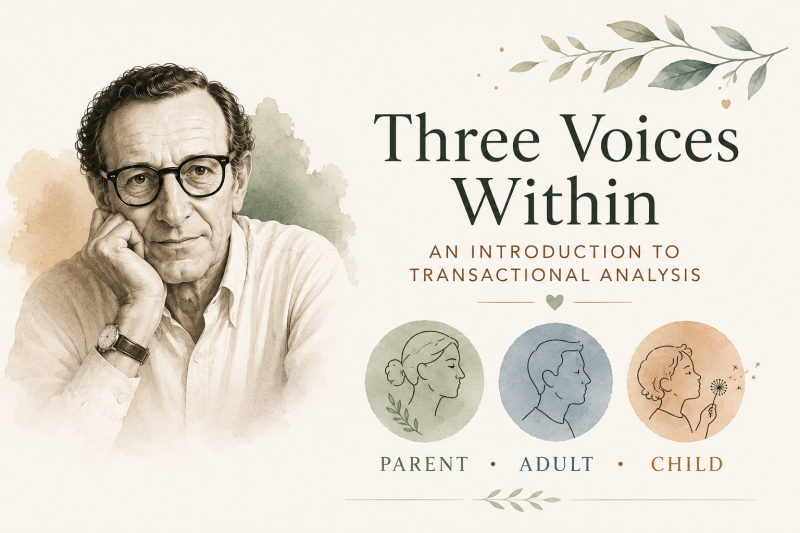
Transactional Analysis gives these parts names: "Parent," "Adult," and "Child."
Transactional Analysis, often called TA, was developed in the 1950s by Eric Berne, a psychiatrist who wanted psychological ideas to be easier for people to understand and use in everyday life. Instead of keeping therapy language distant or overly abstract, Berne paid attention to real conversations: how people speak, how they react, how they misunderstand each other, and how old emotional patterns appear in present relationships.
At the center of TA are three ego states.
"Parent" is the part of us that carries internalized voices from important people and systems in our lives. It may hold values, rules, protection, criticism, care, duty, and expectations.
"Adult" is the part of us that tries to respond to the present moment. It gathers information, evaluates reality, and asks, “What is actually happening right now?”
"Child" is the part of us that carries early feelings, needs, fears, creativity, spontaneity, and vulnerability.
I often think of these three ego states as fellow travelers.
The Parent carries old maps.
The Child notices what feels exciting, painful, or frightening.
The Adult looks out the window and asks, “Where are we now?”
This matters because many conflicts are not only about the words being spoken. They are also about which part of each person is speaking.
A person may ask a simple question from their Adult state, but the other person may hear it through the Child part that expects criticism. Someone may offer advice from a caring Parent state, while the other person experiences it as control. A small conversation can become emotionally charged because the present moment has touched an older place inside.
In TA, these exchanges are called "transactions." Some transactions flow smoothly. Others become crossed, and that is often when people feel confused, defensive, dismissed, or misunderstood.
This is one of the reasons I find TA useful. It helps people pause and ask:
Which part of me is speaking right now?
Which part of me is reacting?
Am I responding to what is happening now, or to something familiar from the past?
TA also introduced the idea of "life scripts," the unconscious stories we begin forming early in life about who we are, what relationships are like, and what we can expect from the world. These scripts are not chosen deliberately. They often develop quietly, through repeated experiences, family patterns, culture, attachment, disappointment, protection, and survival.
Therapy can help bring these scripts into awareness.
Not so we can blame ourselves for having them.
Not so we can blame the people who shaped them.
But so we can begin to notice when an old map is guiding a present-day road.
Berne also wrote about "games," recurring patterns people can fall into with one another. These are not games in the playful sense. They are familiar relational patterns that often lead to predictable emotional outcomes. A person may end up feeling rejected, superior, helpless, guilty, misunderstood, or abandoned again and again, even when the details of the situation change.
TA asks us to become curious about these patterns rather than ashamed of them.
What is being repeated?
What is the hidden emotional payoff?
What does this pattern protect?
What would it mean to respond differently?
At its heart, Transactional Analysis is about freedom.
The freedom to notice.
The freedom to pause.
The freedom to ask whether the voice speaking inside us belongs to the present moment or to an earlier chapter of life.
I think that is why TA has remained meaningful for so many people. Beneath its simple language is a compassionate idea: when we understand our inner patterns, we gain more choice.
And when we have more choice, change becomes possible.
If you recognize yourself in these patterns and want support understanding your own inner dialogue, therapy can be a place to begin listening with more compassion and choice.
For support understanding your own inner dialogue and relationship patterns, explore individual psychotherapy or schedule a free 15-minute consultation. I offer online therapy for adults in Maryland.